

A 3D culture platform unlocks extracellular vesicle therapy for fibrotic skin repair
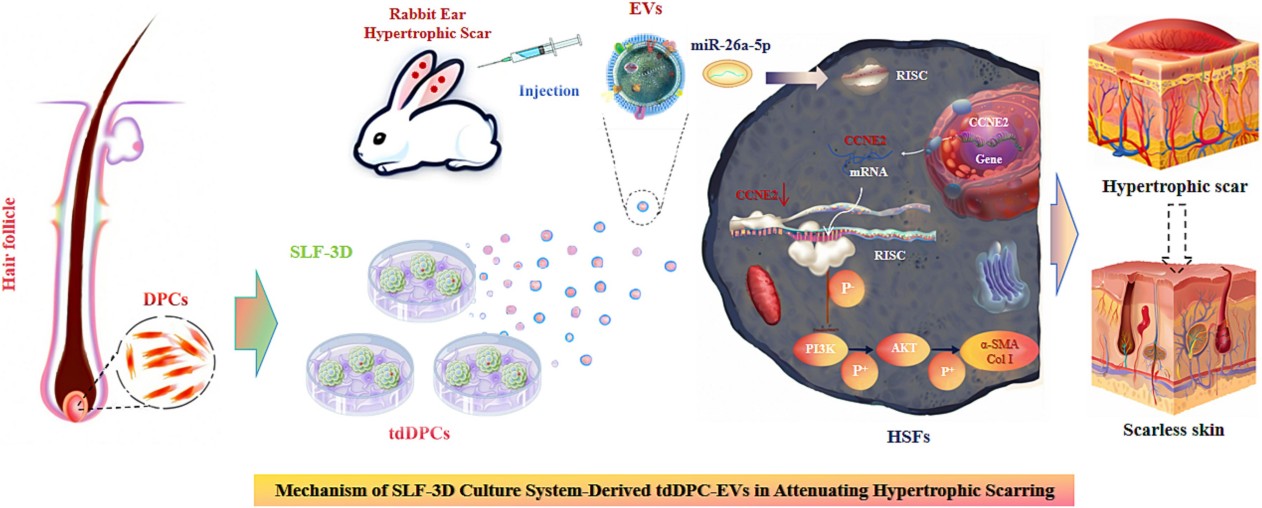
Self-Organizing 3D Culture–Derived Extracellular Vesicles Suppress Hypertrophic Scarring via the miR-26a-5p–CCNE2 Axis. Schematic illustration of the therapeutic mechanism by which self-feeder layer three-dimensional (SFL-3D) culture–derived dermal papil
GA, UNITED STATES, March 16, 2026 /EINPresswire.com/ -- Hypertrophic scars remain one of the most persistent challenges in wound healing, often resulting in excessive fibrosis, disfigurement, and long-term functional impairment. Researchers now report a scalable, cell-free therapeutic strategy that directly targets the biological drivers of pathological scarring. By engineering self-organizing three-dimensional spheroids from dermal papilla cells, the team generated extracellular vesicles enriched with antifibrotic regulatory signals. These vesicles suppressed abnormal fibroblast activation, reduced excessive collagen deposition, and promoted scar regression in experimental models. Rather than replacing damaged tissue, the approach reprograms the wound microenvironment to interrupt the self-reinforcing cycle of fibrosis. The findings highlight a new paradigm for scar treatment that combines precision molecular targeting with manufacturable regenerative medicine technologies.
Hypertrophic scarring affects a large proportion of patients following burns, trauma, or surgery and arises from prolonged fibroblast hyperactivity and excessive extracellular matrix accumulation. Current treatments—such as corticosteroid injections, laser therapy, or surgical revision—offer limited and often temporary relief, while cell-based regenerative approaches face challenges including immune risks, poor scalability, and loss of cellular potency during expansion. Hair follicle-derived dermal papilla cells are known to modulate fibrosis through paracrine signaling, yet their therapeutic potential is restricted by rapid senescence in conventional culture systems. Based on these challenges, there is a critical need to develop scalable, cell-free strategies that can precisely regulate fibrotic signaling and restore balanced wound healing.
In a study published in Burns & Trauma in 2025, a research team led by clinicians and scientists from Xijing Hospital of the Fourth Military Medical University, Lanzhou University Second Hospital, and Shanghai Ninth People’s Hospital affiliated with Shanghai Jiao Tong University School of Medicine (China) reports a novel three-dimensional culture platform that enables long-term expansion of functional dermal papilla cells and the production of therapeutically potent extracellular vesicles. Using this system, the team demonstrated that vesicles derived from self-organized spheroids significantly reduced hypertrophic scar formation in both cellular and animal models through a microRNA-regulated antifibrotic mechanism.
The researchers developed a self-feeder layer three-dimensional (SFL-3D) culture system in which dermal papilla cells spontaneously organize into semiadherent spheroids supported by an underlying feeder layer. Unlike conventional two-dimensional or forced-aggregation three-dimensional cultures, this architecture preserved cell viability, stem-like properties, and secretory activity over extended passages, enabling stable large-scale production of extracellular vesicles. These vesicles were efficiently internalized by hypertrophic scar-derived fibroblasts, where they markedly inhibited cell proliferation, migration, and myofibroblast differentiation.
Transcriptomic and functional analyses identified a key regulatory axis underlying the antifibrotic effects. Vesicles produced by the SFL-3D system were enriched in miR-26a-5p, a microRNA that directly targets CCNE2, a gene encoding a cell-cycle regulator implicated in fibrotic progression. Suppression of CCNE2 disrupted downstream PI3K/AKT signaling, resulting in reduced collagen overproduction and decreased expression of α-smooth muscle actin, a hallmark of myofibroblast activation. In a rabbit ear hypertrophic scar model, vesicle treatment significantly lowered scar elevation, restored the collagen I/III ratio toward physiological levels, and improved overall tissue architecture. Together, the findings demonstrate that reprogrammed extracellular vesicles can precisely dismantle the molecular feedback loops that sustain pathological fibrosis.
“Our findings show that hypertrophic scarring can be addressed by targeting its molecular engine rather than merely treating its visible symptoms,” the authors noted. “By selectively modulating the miR-26a-5p–CCNE2 regulatory axis, this approach interrupts the signaling cascades that drive fibroblast hyperactivation and excessive matrix deposition. Importantly, the strategy avoids the risks associated with live-cell therapies while retaining strong biological efficacy. This work demonstrates how three-dimensional culture engineering and extracellular vesicle biology can be combined to deliver precise, controllable, and clinically translatable antifibrotic interventions.”
As a cell-free therapeutic modality, dermal papilla cell-derived extracellular vesicles offer advantages in safety, storage stability, and large-scale manufacturing compared with conventional cell-based approaches. By modulating fibroblast behavior through the miR-26a-5p–CCNE2 pathway, this strategy provides a precision framework for controlling pathological fibrosis. Beyond hypertrophic scars, the approach may be extended to other fibrotic disorders characterized by dysregulated fibroblast activity, including organ fibrosis and chronic nonhealing wounds. The SFL-3D culture platform also establishes a versatile manufacturing pipeline for producing therapeutic vesicles with defined molecular cargo, accelerating the clinical translation of extracellular vesicle–based regenerative medicine.
References
DOI
10.1093/burnst/tkaf048
Original Source URL
https://doi.org/10.1093/burnst/tkaf048
Funding information
This work was supported by grants from the National Natural Science Foundation of China (No. 82272268, 82360444), Gansu Province University Industry Support Project (2023CYZC-02), Cuiying Technology Innovation Project of Lanzhou University Second Hospital (CY2022-MS A04) and the Key Research and Development Program of Shaanxi Province (2024SF-ZDCYL 04-10).
Lucy Wang
BioDesign Research
email us here
Legal Disclaimer:
EIN Presswire provides this news content "as is" without warranty of any kind. We do not accept any responsibility or liability for the accuracy, content, images, videos, licenses, completeness, legality, or reliability of the information contained in this article. If you have any complaints or copyright issues related to this article, kindly contact the author above.
