

State vs Big Tech: Inside Matthew Platkin’s Push for AI Accountability on the RegulatingAI Podcast with Sanjay Puri

RegulatingAI Podcast
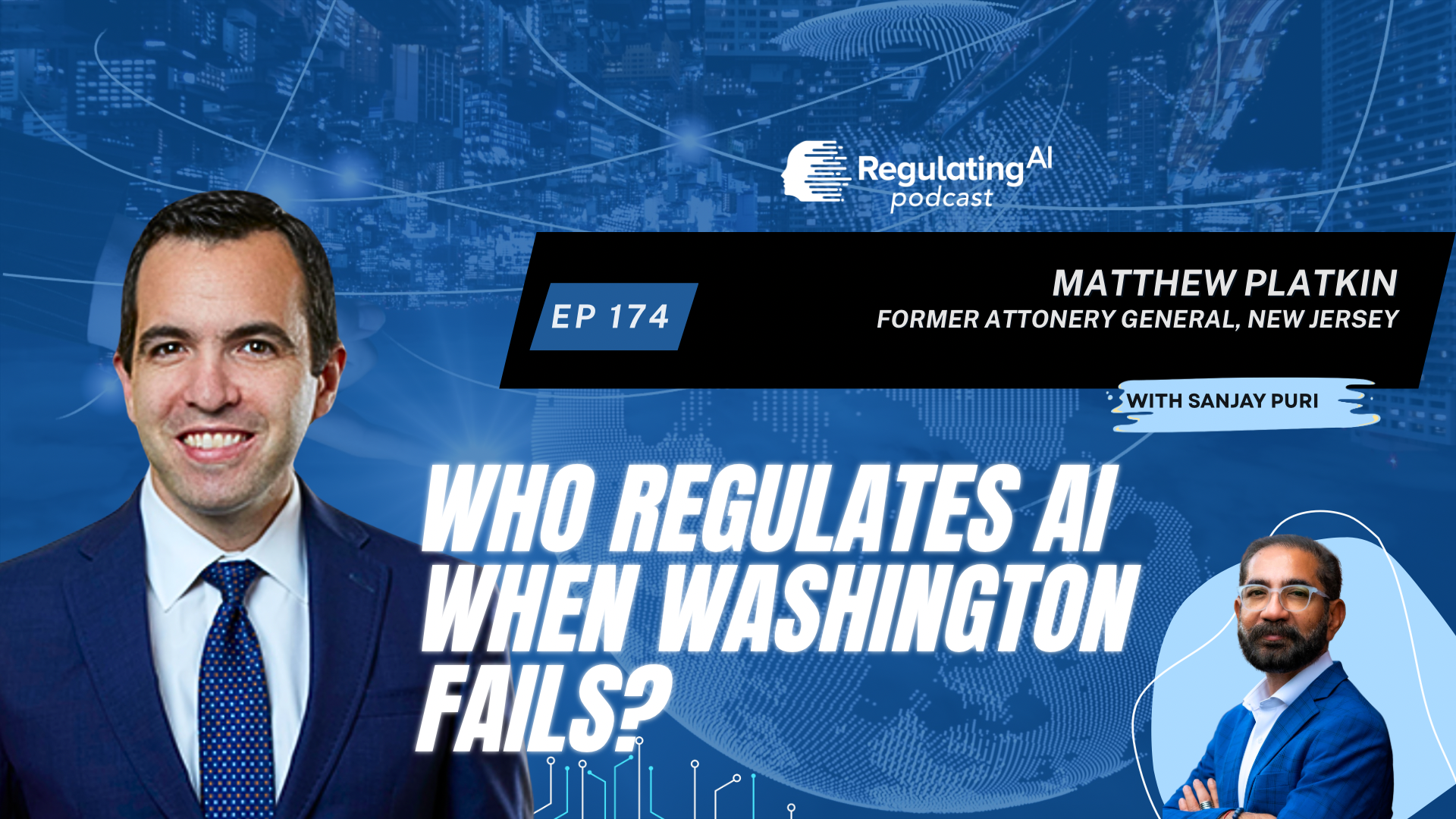
Matthew Platkin, Attorney General, New Jersey, with Sanjay Puri, President of RegulatingAI
Matthew Platkin on the Regulating AI Podcast with Sanjay Puri discusses AI accountability, state vs. federal regulation, Section 230 reform, and tech liability.
Platkin explains that the Attorney General’s office has both civil and criminal authority, but its most relevant function in the AI context is consumer protection. He emphasizes that companies cannot misrepresent the safety of their products while being aware of harmful outcomes. Drawing parallels to historical cases involving tobacco and opioid industries, he argues that similar legal frameworks already exist and can be applied to AI systems without requiring entirely new categories of law. According to him, AI systems that influence children’s mental health, amplify addiction-like engagement patterns, or generate harmful outputs fall within the scope of existing consumer protection doctrines.
A significant portion of the conversation addresses the growing conflict between state and federal authority in AI governance. Platkin highlights his leadership in a bipartisan coalition of 36 state attorneys general that opposed federal preemption efforts aimed at restricting state-level AI regulation. He explains that while industry leaders and some policymakers argue for a unified federal framework—often citing national security concerns and regulatory consistency—states have historically played a critical role in protecting consumers. He cites examples such as tobacco litigation and opioid enforcement to illustrate how state-level action often precedes and strengthens national regulatory responses. Platkin strongly defends the federalist structure of the United States, arguing that states serve as “laboratories of democracy,” capable of experimenting with regulatory approaches and responding quickly to emerging harms. He criticizes the idea that only the federal government should regulate AI, noting that federal institutions have historically been slow to adapt to technological change. He also raises concerns about corporate lobbying influence in Washington, suggesting that large technology firms have shaped regulatory outcomes in ways that reduce accountability.
The discussion then shifts to Section 230 of the Communications Decency Act, a legal provision that shields online platforms from liability for user-generated content. Platkin argues that Section 230 is outdated and overly protective of large technology companies, particularly in the context of modern AI systems and social media platforms. He states that trillion-dollar companies should not be immune from accountability when their platforms contribute to real-world harm, including mental health crises among youth or the spread of misinformation. While acknowledging that courts have already narrowed some interpretations of Section 230, he calls for either significant reform or full repeal, arguing that the current legal framework fails to reflect the scale and influence of modern digital platforms. On the question of innovation, Platkin rejects the notion that regulation and innovation are inherently in conflict. He uses analogies such as seatbelts in cars and pharmaceutical approval processes to argue that safety regulations often enable, rather than hinder, long-term innovation. He notes that the United States remains a global leader in pharmaceutical development despite strict oversight mechanisms, suggesting that similar approaches could be applied to AI governance. According to him, the idea that innovation requires the absence of regulation is a false trade-off promoted by industry interests.
The conversation also addresses urgent concerns around AI misinformation, deepfakes, and digital scams. Platkin warns that AI-generated content is already being used to create convincing fake videos, audio, and images, making it increasingly difficult for the public to distinguish authentic information from fabricated material. He highlights the risk this poses not only to democratic processes but also to vulnerable populations, including seniors who are frequently targeted by AI-driven scams. He acknowledges that existing legal tools, including First Amendment protections and Section 230 limitations, constrain enforcement in some cases but insists that stronger accountability mechanisms are necessary. Platkin further compares AI governance to historical regulation of nuclear technology, arguing that society has successfully managed high-risk technologies in the past through international cooperation and strict oversight frameworks. He suggests that similar global discussions may be necessary for AI, including the possibility of an international regulatory body akin to the International Atomic Energy Agency. While acknowledging that such ideas may seem ambitious, he argues that the scale of AI’s potential impact justifies serious consideration of global coordination.
In closing, Platkin reiterates that liability is essential for responsible AI deployment. Without legal consequences for harm, he argues, companies lack sufficient incentive to prioritize safety over speed and profit. He also highlights his office’s use of technology in civil rights enforcement, demonstrating how AI can be leveraged for public good when paired with ethical safeguards. Overall, the discussion presents a clear tension between innovation and accountability, with Platkin advocating for stronger legal frameworks to ensure that AI development proceeds responsibly while still allowing technological progress to flourish.
Upasana Das
Knowledge Networks
email us here
Visit us on social media:
LinkedIn
Instagram
Facebook
YouTube
X
Legal Disclaimer:
EIN Presswire provides this news content "as is" without warranty of any kind. We do not accept any responsibility or liability for the accuracy, content, images, videos, licenses, completeness, legality, or reliability of the information contained in this article. If you have any complaints or copyright issues related to this article, kindly contact the author above.
