
Display chemicals accumulate in Arctic, Antarctic, and Qinghai-Xizang Plateau soils
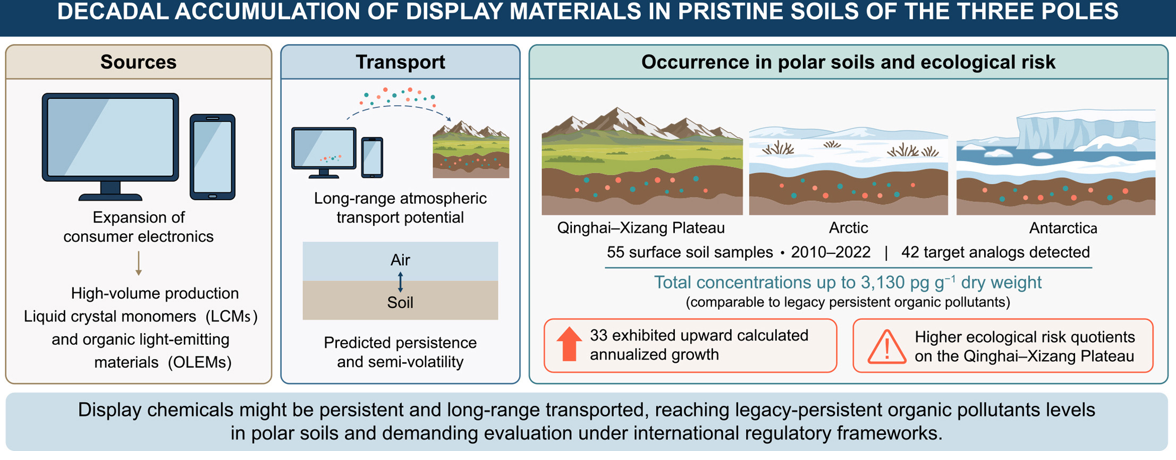
Decadal accumulation of display materials in pristine soils of the Three Poles.
FAYETTEVILLE, GA, UNITED STATES, October 9, 2026 /EINPresswire.com/ -- Synthetic chemicals with long-range transport potential are increasingly scrutinized under international chemical treaties. The rapid growth of consumer electronics has led to massive production of liquid crystal monomers (LCMs) and organic light-emitting materials (OLEMs). Although models predict that these compounds are persistent and semi-volatile, field evidence from remote cryospheric sinks has been lacking. This study analyzed surface soils from the Qinghai-Xizang Plateau (QXP), the Arctic, and the Antarctic, and found widespread occurrence of display-related chemicals. The results show upward temporal trends for many analogs and indicate that these chemicals can undergo long-range transport and accumulate in pristine soils.
Persistent organic pollutants (POPs) are regulated under the Stockholm Convention because of their long-term risks to ecosystems and human health. Assessing environmental persistence and long-range transport potential (LRTP) is therefore essential for identifying new candidate POPs. The Arctic, the Antarctic, and the Qinghai-Xizang Plateau (QXP) are sensitive indicators of contaminant transport, yet data gaps remain for high-production industrial chemicals used in modern electronics. liquid crystal monomers (LCMs) and organic light-emitting materials (OLEMs) have been detected in soil, water, sediment, and biota, and some show predicted toxicity, persistence, and semi-volatility. However, field evidence from remote polar soils is scarce. Given these knowledge gaps, in-depth research is needed on the environmental persistence, long-range transport, and ecological risks of display-related chemicals in remote cryospheric soils.
In a study published (DOI: 10.1016/j.ese.2026.100770) online 23 September 2026 in Environmental Science and Ecotechnology, researchers from Jianghan University, Beijing Normal University, Linköping University, the Chinese Academy of Sciences, and Xizang University examined 55 surface soil samples from the QXP, Arctic, and Antarctic collected between 2010 and 2022. They detected 42 display-related analogs, characterized their spatiotemporal patterns, and conducted a screening-level ecological risk assessment. The work provides field-based evidence on their persistence and long-range transport.
The team detected a broad suite of display chemicals across all three polar regions, including fluorinated biphenyls and their analogs (FBAs), cyanobiphenyls and their analogs (CBAs), biphenyls/bicyclohexyls and their analogs (BAs), and OLEMs. Total concentrations were comparable to levels of legacy POPs in remote environments. Notably, many analogs showed higher concentrations in more recent sampling campaigns, suggesting ongoing environmental input and accumulation. The composition differed by region: FBAs dominated on the QXP and in the Antarctic, while CBAs were more prominent in the Arctic; BAs made a relatively larger contribution in the Antarctic than on the QXP. The researchers also found that soil organic carbon (TOC) correlated with hydrophobic compounds, indicating that soil organic matter helps retain these chemicals. Spatial patterns did not differ significantly between sites near research stations and more distant locations, supporting long-range atmospheric transport as a primary pathway. Screening risk quotients (RQs) were up to two orders of magnitude higher on the QXP than in polar sites, highlighting greater potential ecological concern in the high-altitude region. The authors note that continued release of these “chemicals in use” may gradually increase exposure in vulnerable cryospheric ecosystems.
The authors noted the decade-spanning dataset provides field-based evidence that display chemicals are not confined to manufacturing hubs or cities. According to the authors, rising concentrations of fluorinated and cyano-substituted congeners suggest that LCMs and OLEMs can undergo regional or long-range atmospheric transport and accumulate in remote cryospheric soils. They said the results support prioritizing high-production optoelectronic materials for further toxicity testing, atmospheric monitoring, and international chemical screening. They suggest the findings support evaluating such materials under international regulatory frameworks.
The findings have implications for chemical regulation, environmental monitoring, and risk management. As display-related chemicals remain in use and production expands, their continued release may gradually increase exposure in vulnerable polar and high-altitude ecosystems. The authors call for experimentally measured soil toxicity data, improved emission inventories, multimedia fate modeling, and source apportionment to reduce uncertainty. They also recommend evaluating LCMs and OLEMs under international frameworks such as the Stockholm Convention, where persistence and LRTP are key criteria. Such steps would help regulators identify problematic analogs earlier and protect remote environments from long-term contamination.
References
DOI
10.1016/j.ese.2026.100770
Original Source URL
https://doi.org/10.1016/j.ese.2026.100770
Funding Information
This study was supported by the National Natural Science Foundation of China (42476261, 22406067, 22193051, 22136006), the project of cooperation between the Chinese Academy of Engineering and local government (HB2025B19), and the China Scholarship Council (202508420136).
Lucy Wang
BioDesign Research
Legal Disclaimer:
EIN Presswire provides this news content "as is" without warranty of any kind. We do not accept any responsibility or liability for the accuracy, content, images, videos, licenses, completeness, legality, or reliability of the information contained in this article. If you have any complaints or copyright issues related to this article, kindly contact the author above.
